

In today’s increasingly digital world, the landscape of civil litigation has been fundamentally reshaped by technology. From personal injury cases to business disputes and intellectual property theft, digital evidence plays a central role in establishing truth. As a result, digital forensic consultants for civil litigation are more in demand than ever before, offering vital expertise that bridges the gap between complex digital data and the legal system.
Understanding the Role of Digital Forensic Consultants
Digital forensic consultants are specialists trained to extract, preserve, analyze, and present digital evidence in a legally admissible manner. In civil litigation, they help attorneys and clients uncover critical information stored in electronic devices, communications, and multimedia content. Their ability to recover deleted files, analyze metadata, and interpret usage patterns makes them indispensable in today’s data-driven courtrooms.
Unlike criminal cases, civil litigation typically involves private disputes between individuals or organizations. In these scenarios, digital forensic consultants can play a crucial role in proving liability, demonstrating damage, and uncovering fraudulent behavior.
Key Drivers Behind the Growing Demand
1. Increased Digital Interactions
As nearly every communication and transaction leaves a digital footprint—emails, text messages, social media activity, mobile app usage—litigants increasingly rely on digital evidence. Civil cases involving defamation, harassment, and contract breaches often hinge on digital communications that need expert interpretation and authentication.
2. Explosion of Mobile Device Use
The proliferation of smartphones and tablets has turned mobile device forensics into a vital branch of digital investigation. These devices contain a wealth of evidence, including call logs, geolocation data, chat histories, and app usage statistics. In civil litigation, mobile device evidence can help clarify timelines, verify alibis, and confirm user behavior.
With so much sensitive data stored on mobile devices, digital forensic consultants use specialized tools to extract and preserve information without compromising its integrity. Their expertise ensures that the evidence is collected in compliance with legal protocols, maintaining its admissibility in court.
3. Complexities of Digital Multimedia Evidence
Multimedia content—such as video and audio files—has become a cornerstone in various civil cases. Whether it’s surveillance footage from a business premises or a voice recording presented in a workplace dispute, the reliability of these files often comes into question. This is where an audio forensic expert or a digital video forensics consultant becomes essential.
These professionals are trained to authenticate recordings, detect tampering, clarify speech or images, and match them to specific devices or users. Their technical reports and testimony can significantly strengthen a case by validating or refuting the content presented by either party.
4. Rise in Intellectual Property Disputes
In the digital age, intellectual property theft no longer requires physical access to documents or assets. With a few clicks, confidential data can be stolen, duplicated, or distributed online. Civil suits involving trade secrets, copyright infringement, or data breaches often require the skills of digital forensic consultants to trace digital footprints, identify the breach’s source, and quantify damages.
Types of Digital Evidence in Civil Cases
Digital forensic consultants work with a wide range of evidence sources, including:
- Emails and Text Messages: Used to support claims of defamation, breach of contract, or harassment.
- Social Media Activity: Helps verify statements or disprove timelines.
- GPS and Location Data: Useful in personal injury claims or employee misconduct cases.
- Digital Video Files: Surveillance footage or recordings used to support or refute claims.
- Voice Recordings: In workplace disputes or verbal agreements, evaluated by an audio forensic expert.
- Mobile Devices: Central to most modern civil cases, as they house multiple data types.
- Cloud Storage and Backups: Can hold hidden or deleted documents and evidence.
Common Civil Litigation Cases Involving Digital Forensics
Personal Injury and Insurance Claims
In personal injury lawsuits, plaintiffs must prove the extent of injury and causation. Digital evidence, such as location data or surveillance footage, can support or contradict testimony.

Insurance companies may also use digital forensics to uncover fraud, like exaggerated claims or staged incidents.
Employment and Labor Disputes
Digital forensic consultants are often called in to analyze internal communications, mobile phone activity, or computer usage when dealing with wrongful termination, discrimination, or breach of non-compete agreements.
Divorce and Custody Battles
In family law cases, evidence from mobile phones, emails, or social media may play a pivotal role. Allegations of infidelity, hidden assets, or unfit parenting can be substantiated—or disproven—by a forensic analysis of digital devices.
Intellectual Property and Trade Secrets
Businesses use digital forensic experts to identify internal leaks, trace the theft of intellectual property, and determine how sensitive data may have been compromised or shared.
Real Estate and Contract Disputes
Digital evidence can clarify whether contractual obligations were met, using timestamped communications, transaction records, or document metadata.
The Role of Audio and Video Forensics in Civil Litigation
Importance of an Audio Forensic Expert
An audio forensic expert specializes in the analysis and interpretation of sound recordings. Their tasks may include:
- Enhancing speech for clarity
- Authenticating recordings
- Detecting tampering or edits
- Matching voices or identifying speakers

In civil litigation, audio experts can help determine the credibility of verbal agreements, provide evidence in harassment cases, or support claims involving workplace misconduct.
Power of Digital Video Forensics
Digital video forensics involves the examination of video footage to validate its authenticity and improve its quality. Experts may stabilize shaky video, clarify blurry images, or analyze frame-by-frame sequences to extract key details. This service is invaluable in slip-and-fall cases, auto accidents, or property disputes, where visual evidence is central to the case.
Legal and Ethical Considerations
The process of acquiring and analyzing digital evidence must adhere strictly to legal standards. Improper handling can render evidence inadmissible or raise ethical concerns. Digital forensic consultants for civil litigation are trained in the principles of chain of custody, data integrity, and privacy law compliance.
Attorneys must also be cautious not to request or submit digital evidence obtained through unauthorized means, such as hacking or surveillance, without consent. A qualified digital forensic consultant ensures all activities comply with federal and state laws, protecting the credibility of the legal process.
Digital Forensics in Pre-Litigation Strategy
Digital forensics is not limited to courtroom presentation—it plays a vital role in case preparation and settlement negotiations. By uncovering key evidence early, attorneys can:

- Assess case strengths and weaknesses
- Determine the viability of claims
- Avoid unnecessary litigation
- Bolster negotiation positions with strong digital proof
In some cases, digital forensic findings may encourage parties to settle out of court, saving time and costs.
Challenges and Limitations
Despite their growing importance, digital forensic investigations come with challenges:
- Encryption and Security: High-level encryption can hinder data extraction.
- Data Overload: Sorting through massive amounts of information requires time and expertise.
- Rapid Technological Changes: Tools and techniques must constantly evolve to keep pace.
- Privacy Concerns: Accessing data without violating privacy rights requires delicate handling and sometimes legal intervention, such as subpoenas.
However, skilled consultants are trained to navigate these issues while delivering reliable, legally admissible results.
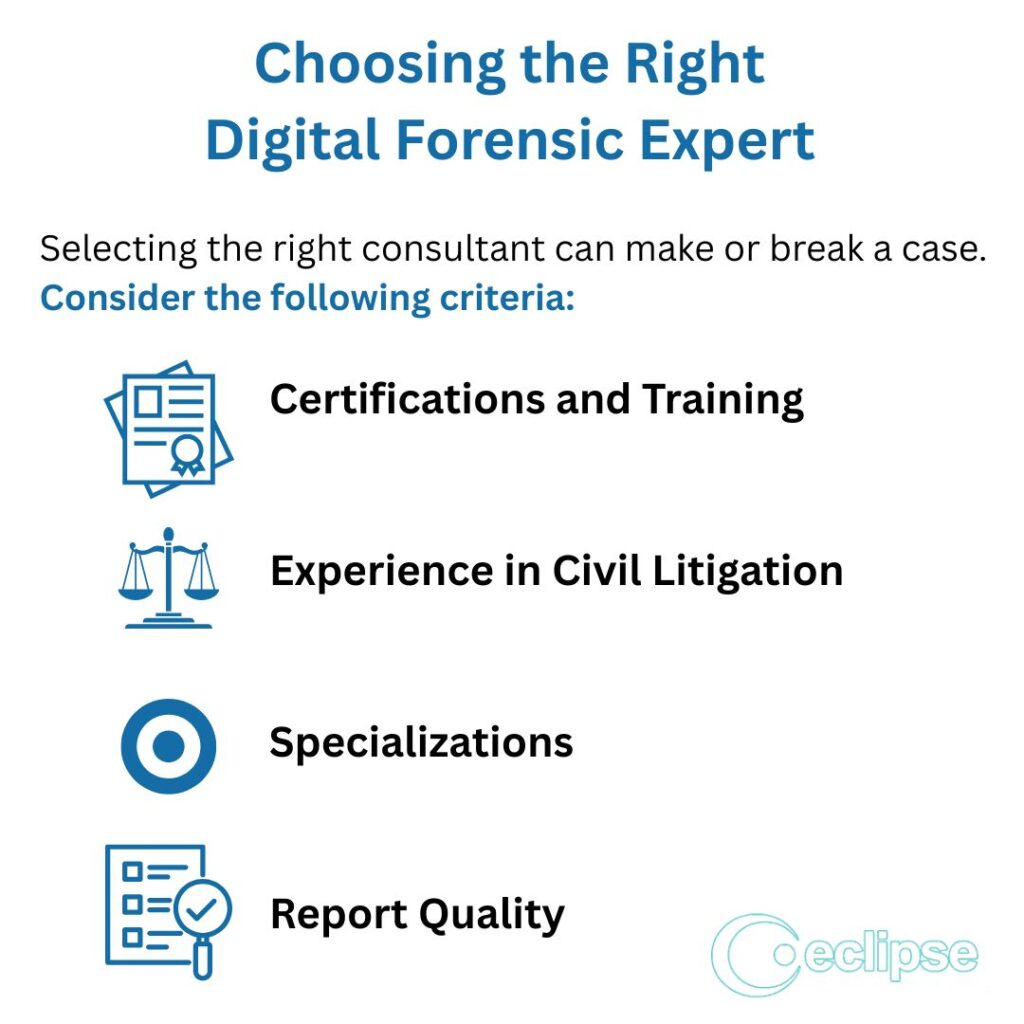
Choosing the Right Digital Forensic Expert
Selecting the right consultant can make or break a case. Consider the following criteria:
- Certifications and Training: Look for credentials like CFCE (Certified Forensic Computer Examiner) or certifications in mobile forensics and video/audio analysis.
- Experience in Civil Litigation: Ensure the consultant understands courtroom procedures and can provide expert testimony.
- Specializations: Choose consultants with expertise relevant to your case—such as an audio forensic expert or mobile device forensics analyst.
- Report Quality: Well-documented, easy-to-understand reports are critical for legal teams and juries alike.
The Future of Digital Forensics in Civil Law
As technology continues to advance, the role of digital forensic consultants will only grow. With artificial intelligence, IoT devices, and blockchain data becoming more prevalent, forensic specialists must adapt their methods and tools accordingly. New challenges, such as deepfakes or AI-generated content, may further complicate civil litigation—underscoring the need for skilled digital analysts.
At Eclipse Forensics, we specialize in uncovering the truth hidden in your digital world. Our team of digital forensic consultants for civil litigation provides expert analysis of mobile devices, video, and audio recordings to support your case with precision and credibility. Whether you need a trusted audio forensic expert to verify voice evidence or advanced mobile device forensics to recover critical messages, we deliver courtroom-ready results with integrity. Our digital video forensics services enhance, authenticate, and validate footage to ensure every visual detail is clear and admissible. Trust Eclipse Forensics to be your strategic partner in navigating complex digital evidence, because in today’s litigation landscape, every byte counts.