A person checking a phone.

Privacy and Evidence: Balancing Rights in Mobile Forensics

In contemporary investigations, the tension between gathering critical evidence and respecting individual rights has never been more intense. This is especially true in mobile device forensics, where investigators seek to extract text messages, call logs, location data, photos, apps, and other highly personal content.

The question arises: how can we conduct investigations without trampling privacy? This blog delves deeply into mobile forensics privacy issues, exploring the ethical and legal chasms, the responsibilities of forensic professionals, and how the right protocols uphold both justice and privacy.

The Promise and Peril of Mobile Forensics

Mobile devices are ubiquitous and deeply personal. They contain treasure troves of personal data, making them prime targets in criminal investigations. On the one hand, forensic cell phone data recovery may reveal critical evidence; on the other, it threatens to expose private communications and intimate details.

Thus, mobile forensics is a double‑edged sword. Investigators and legal authorities must grapple with complex questions: When does searching a phone cross a privacy boundary? How do we authenticate video or audio evidence without overreaching? What safeguards exist to prevent abuse? Let’s explore it further.

The Legal Landscape: Search, Warrant & Fourth Amendment

The Fourth Amendment and Digital Searches

In the United States, the bedrock protection for privacy is the Fourth Amendment, which guards citizens against unreasonable searches and seizures. A mobile device is often treated as a repository of private life, so investigators generally must secure a warrant before conducting a search.

The scope of that warrant must be sufficiently specific—detailing what data or categories may be searched—so the investigator does not conduct a sweeping, privacy-intrusive search of irrelevant content.

Courts have wrestled with how to apply Fourth Amendment rules to mobile devices. Some rulings require “search incident to arrest” exceptions only when limited in scope; others require a “digital lock” warrant. The key principle is proportionality: any intrusion must be no more than necessary to achieve legitimate investigative goals.
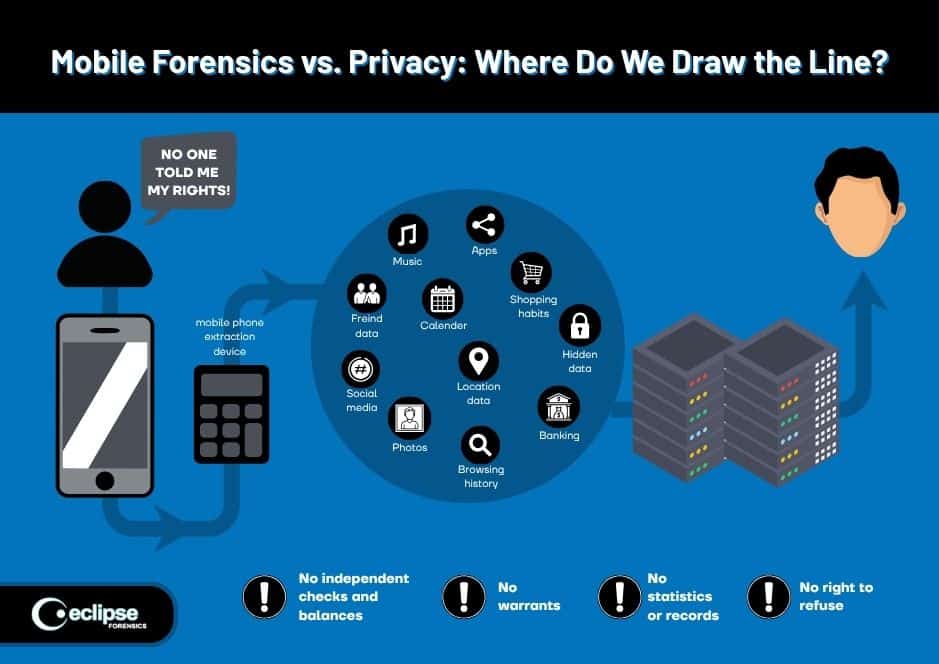
Graphics showing privacy rights in mobile forensics.

Statutes Like ECPA and SCA

Beyond constitutional protections, the Electronic Communications Privacy Act (ECPA) and Stored Communications Act (SCA) place additional constraints on accessing stored communications or data held by service providers. Investigators must tread carefully: simply obtaining a warrant may not suffice if statutory protections apply.

For example, retrieving messages stored in the cloud, tied to a phone, often implicates these laws. A digital forensic consultant must be well-versed in both constitutional and statutory regimes before engaging in extraction or requesting third‑party data.

Jurisdiction and CrossBorder Data

Mobile data may exist across multiple jurisdictions, especially when cloud sync or remote backups are involved. A warrant issued in State A may not automatically permit the extraction of cloud‑stored data in State B or another country. That means a cyber forensic expert and data forensic expert must coordinate with legal counsel to ensure proper authority, prevent cross‑jurisdictional overreach, and respect data sovereignty.

Ethical Challenges: Scope, Relevance, and Minimization

Principle of Proportionality

Even when legal authority is obtained, forensic practitioners must remain ethically disciplined. They must continuously ask: Is the data I seek proportional to the offense? For example, in a theft case, it may be unjustified to explore a suspect’s social media chats about personal relationships. The intrusion must remain strictly tailored. That involves deploying search filters, keyword constraints, or segmented extraction methods to avoid unnecessary access.

Avoiding “Fishing Expeditions”

One of the most abused practices is the “fishing expedition” — where investigators pull more data than authorized, hoping something incriminating appears. This morally dangerous approach undermines privacy rights and can jeopardize admissibility in court. A forensic computer analyst or digital forensic engineer must resist temptation and stay within the legally permitted boundary.

Data Minimization and Redaction

Ethical mobile forensics demands data minimization: isolating and retaining only relevant evidence while redacting or discarding extraneous personal content. For example, if certain messages or images are irrelevant, they should not be retained or disclosed. This reduces the risk of privacy violations and minimizes exposure of innocuous private details.
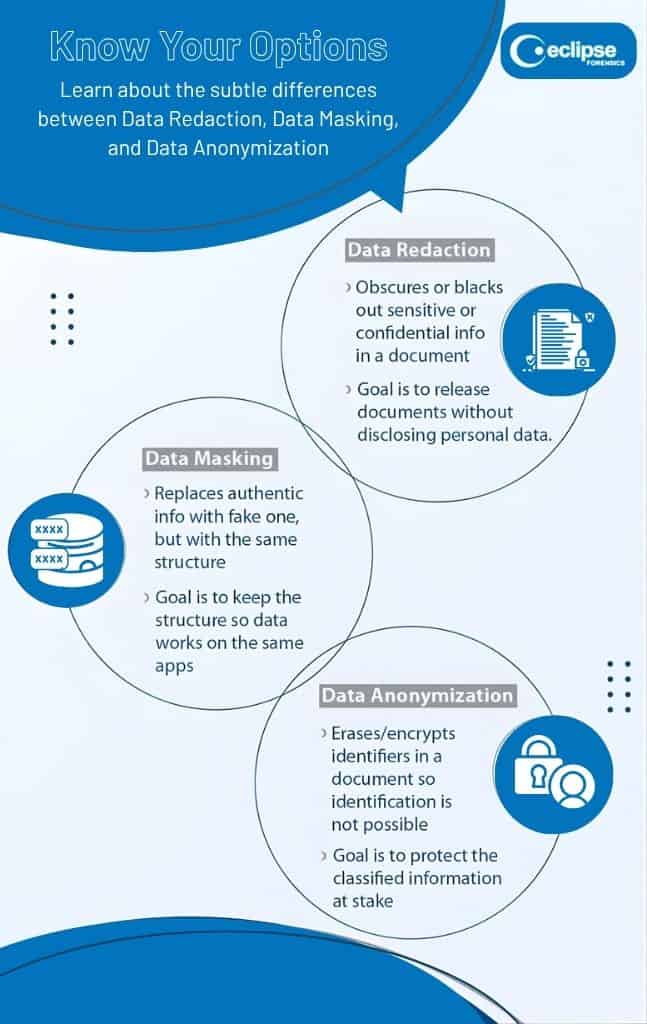
Graphics showing the difference between data redaction, data masking, and data anonymization.

Transparency and Accountability

Investigators should maintain meticulous logs of their processes, demonstrating the chain of custody, extraction parameters, tool usage, and any filtering or redaction conducted. Transparency is essential both ethically and legally. A computer forensics consultant may need to produce these logs in disclosure motions or judicial review.

Technical Considerations: Encryption, Tools, and Limitations

Encryption and Access Resistance

Modern mobile devices often employ strong encryption (e.g., full-disk encryption, hardware-backed encryption). These protections are essential for user privacy but present hurdles for investigators.

Breaking encryption can require advanced technical tools, exploits, or cooperation from manufacturers—each raising its own legal and ethical implications. Should an investigator compel a suspect to unlock a device? Some courts permit it, others view it as self-incrimination. A mobile device forensics expert must stay updated on the evolving technical and legal landscape.

Forensic Tool Accuracy and Validation

Any tools used to extract or analyze data must be validated, tested, and reliably documented. Courts will demand proof that the tools preserve data integrity and do not introduce artifacts. Forensic practitioners must understand the inner workings of software and hardware to avoid misinterpretation of recovered data.

Authenticating Video and Audio

When investigators recover video or audio from mobile devices, further challenges arise. Forensic video analysis experts and video forensic experts must authenticate and analyze the content, discerning if it was edited, spliced, or manipulated. Similarly, audio forensic services must verify that recordings are genuine, untampered, and accurately represent the original. The authentication process must itself respect privacy, avoiding exposure of extraneous private parts of a recording that fall outside the investigation’s purview.

A digital forensic consultant at work.

Data Integrity and Chain of Custody

A cornerstone of all forensic work is maintaining the integrity of evidence. From initial forensic cell phone data recovery through analysis and reporting, every step must be documented. Any break in the chain of custody or potential alteration threatens admissibility. Ethical practitioners must adopt best practices like cryptographic hashing, write-blocking, and secure storage.

Mobile Forensics in Practice: Challenges and Case Scenarios

Scenario: Domestic Dispute and Hidden Data

Consider a domestic dispute investigation. A warrant authorizes the extraction of text messages between specific parties during a defined timeframe. During data extraction, an investigator stumbles upon unrelated messages referencing personal health issues or third parties. Ethically, the investigator must pause and assess whether to retain those messages. Unless they are clearly relevant, the messages should be redacted or excluded altogether. Failure to do so could violate privacy and lead to suppression motions.

Scenario: Organized Crime and Broad Authority

In a wide-ranging organized crime investigation, a warrant may permit the extraction of broad categories—call logs, location data, app metadata, and multimedia. The investigative team, with forensic video analysis capabilities, may encounter vast amounts of private content. Here, the oversight of a digital forensic consultant becomes vital to ensure proportional access and compliance with minimization principles, so privacy rights aren’t overwhelmed by overcollection.

Scenario: Cloud Backup and Jurisdictional Issues

A suspect’s mobile device is backed up to a cloud service in another country. The investigation team wants access to synced photos stored overseas. The domestic warrant doesn’t directly authorize foreign server access. The data forensic expert must seek international cooperation, mutual legal assistance treaties (MLATs), or separate legal orders. In the meantime, investigators cannot overreach into data stored in foreign jurisdictions.

Best Practices: Striking the Right Balance

  1. Obtain Specific Legal Authorization: Always acquire search warrants with clearly defined scopes and permissible categories. Avoid vague language that could allow overreach.
  2. Segmented Extraction & Filtering: Use techniques to limit extraction to defined time periods, keywords, apps, or file types. This helps prevent unnecessary exposure to private data.
  3. Use Validated Tools and Methods: Work with accredited and courtroom-accepted tools for digital forensic services to ensure data integrity and defensibility.
  4. Redact Irrelevant Content:After extraction, review and redact data unrelated to the investigation to respect privacy rights.
  5. Maintain Transparent Logs: Document every step—tool used, extraction path, filtering criteria, chain of custody—to provide accountability and defend against suppression challenges.
  6. Expert Peer Review: Engage a digital forensic engineer to review processes, ensuring procedural compliance and ethical discipline.
  7. Collaborate with Legal Counsel: Work closely with prosecutors and defense counsel to ensure warrants comply with the Fourth Amendment, ECPA, SCA, and jurisdictional limits.
  8. Stay Current with Law & Tech: The legal and technical landscape evolves rapidly. A digital video forensics expert must remain updated on trends, new statutes, court decisions, and encryption techniques.

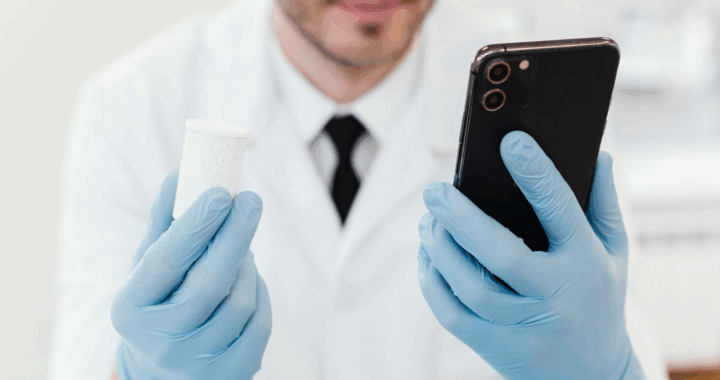
A person reviewing a cellphone for evidence.

Risks, Consequences & Judicial Scrutiny

When forensic professionals overstep, the consequences can be severe. A court may suppress evidence—or the entire forensic extraction—if privacy violations are found. Worse still, misconduct may lead to professional discipline or civil liability.

A judge reviewing a suppression motion will scrutinize whether the search was narrowly tailored, whether the practitioner exceeded the warrant, and whether redaction and minimization occurred. That underscores the imperative for ethical restraint.

Moreover, reputation matters. A law enforcement agency or forensic vendor that earns a reputation for invasive or sloppy mobile forensics can lose credibility, damage trust, and invite public backlash.

Emerging Trends: Privacy-First Approaches and Privacy-Preserving Forensics

As privacy awareness grows and legal standards tighten, more forensic methodologies are adopting privacy-first approaches. One such technique is targeted imaging, where only limited partitions or specific file sets are extracted, rather than a full image dump.

Another is in‑device filtering, where a tool on the device (under legal permission) preselects relevant content before extraction. Some research focuses on homomorphic encryption or secure multiparty computation in forensic settings, allowing pattern matching without fully exposing content.

Additionally, differential privacy techniques may be applied to metadata analysis, where aggregate or anonymized patterns are analyzed without revealing individual content. Still, these are nascent and must align with evidentiary rules.

In parallel, standards bodies and accreditation organizations (e.g., National Institute of Standards and Technology, forensic certifying bodies) are pushing for clear guidelines to limit privacy risk in mobile forensic operations.
A mobile device on a table.

This is not a mere academic debate: real lives and real justice hang in the balance. Each mobile case must be handled with a blend of technical acumen, legal awareness, and moral restraint. When done right, mobile forensics can be a powerful force for truth without trampling the very freedoms it seeks to uphold.

If your investigation demands trustworthy mobile forensics privacy issues handling, choose experts who balance privacy and evidence seamlessly.

Eclipse Forensics stands ready to provide comprehensive mobile device forensics, forensic cell phone data recovery, and other cell phone forensic services while safeguarding individual rights.

Our team includes seasoned digital forensic engineers, forensic video analysis experts, and audio forensic specialists.

Whether you need assistance in digital forensic services, video forensic services, or audio authentication services, we deliver precise, legally defensible results.

From digital forensic consultant guidance to forensic computer analyst reviews, we support law enforcement, legal teams, and private clients. Contact Eclipse Forensics today for reliable, ethical, and expert forensic solutions.
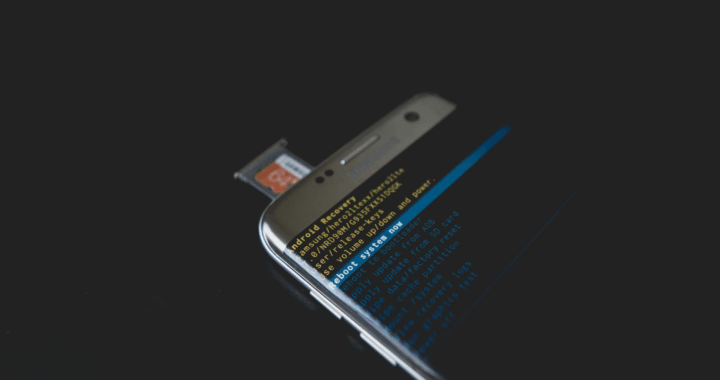
file recovery on a mobile phone

File Extraction in Mobile Forensics: Unlocking Hidden Evidence

In today’s digital-first world, a single smartphone can hold more evidence than an entire file cabinet ever could. Beyond texts and call logs, mobile devices store deleted conversations, hidden images, location data, and encrypted app activity that can completely shift the direction of an investigation.

In today’s age, mobile file extraction forensics is the key to accessing this often-overlooked layer of digital truth. Here’s how it not only helps retrieve data but reveals critical timelines, behaviors, and connections that would otherwise remain buried.

Why Mobile Data Is Crucial in Investigations

Smartphones are central to modern life. According to research, over 91% of U.S. adults own a smartphone, making them a primary source of digital evidence in legal cases. From personal messages to cloud backups, these devices contain unique insights that can’t be found elsewhere. When properly extracted, this information can support criminal investigations, civil litigation, corporate security reviews, and even accident reconstructions.

For investigators, mobile device forensics allows access to deleted files, encrypted data, and fragments stored deep within a phone’s operating system. This makes it an indispensable part of modern legal and cybersecurity strategies.

How File Extraction Works in Mobile Forensics

The process begins with isolating the device to preserve data integrity. Then, forensic specialists use advanced tools to bypass security measures, locate hidden files, and extract relevant data for examination. Forensic cell phone data recovery involves working with structured (e.g., databases) and unstructured data (e.g., deleted texts), ensuring no potential evidence is overlooked.

These methods have advanced significantly, making it possible to extract and interpret encrypted content or fragments of deleted media. A digital forensic engineer may also analyze timestamps, app metadata, and network logs to reconstruct events surrounding a specific incident.

Research highlights how file system artifacts often contain crucial evidence even when data appears erased. This is why precision, proper tools, and expert handling are critical.

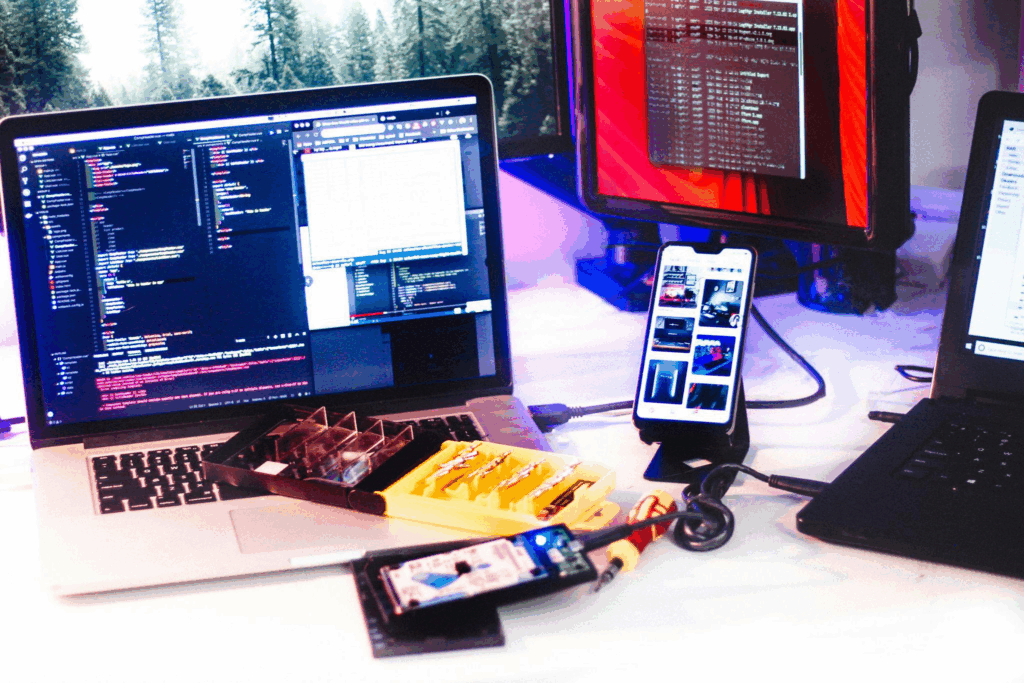
multiple devices set up on a table

The ability to uncover hidden or deleted information can make the difference between a case built on speculation and one supported by hard digital evidence. Advanced mobile file extraction forensics ensures that no crucial detail is overlooked, offering legal teams and investigators a clearer, more accurate picture of the truth.

Eclipse Forensics brings specialized expertise to this critical area. With a focus on cell phone forensic services and advanced mobile device forensics, our team applies cutting-edge techniques to retrieve, preserve, and analyze data from a wide range of devices. We combine the skills of our digital forensic engineers and cyber forensic experts to ensure every piece of extracted information stands up to legal scrutiny.

Whether it’s uncovering deleted communications, reconstructing timelines, or preparing evidence for court, our digital forensic services are built to support high-stakes investigations. Contact us today and learn how our team can assist in uncovering critical digital evidence with precision and reliability.

Advanced smartphone forensic recovery tools used by digital forensic experts

Mobile Forensics in Action: How Experts Recover Crucial Data

In today’s world, nearly every investigation involves a digital trail, and much of that trail lives inside mobile devices. From text messages and call logs to encrypted apps and deleted photos, smartphones often hold critical evidence that can make or break a case. It is where mobile device forensics in FL plays a pivotal role.

One of the most powerful tools in this field is smartphone forensic recovery. This process enables experts to retrieve deleted messages, hidden images, and app histories that many assume are lost forever. For law enforcement, attorneys, and even private investigators, these recovered insights can reveal timelines, motives, and connections that traditional methods miss.

At the heart of this process are skilled professionals, such as a digital forensic consultant or a cyber forensic expert, who use advanced tools and methodologies to extract and preserve hidden data while ensuring its integrity for courtroom presentation. Mobile forensics doesn’t just uncover evidence; it strengthens cases with digital proof that can withstand legal scrutiny.

What is Smartphone Forensic Recovery?

Smartphone forensic recovery is the specialized process of retrieving digital evidence from mobile devices, even when that data has been deleted, hidden, or altered. Unlike a standard phone backup, forensic recovery digs deeper, accessing areas of the device that are not normally visible to users. It includes deleted text messages, call logs, multimedia files, location data, and histories from encrypted or social media apps.

The importance of forensic cell phone data recovery extends across both civil and criminal cases. In family law disputes, for instance, recovering deleted texts or images can clarify timelines and intentions. In criminal investigations, evidence such as GPS records or hidden chat histories may be the key to establishing alibis, disproving claims, or connecting suspects to events.

Eclipse Forensics experts providing digital forensic services in FL

While computer forensics consultants traditionally focused on desktops and laptops, today’s experts must also master the complexities of mobile systems. Smartphones are more challenging because of constant software updates, encryption layers, and the vast amount of personal data they store. It makes smartphone recovery not just a technical service, but a vital investigative tool that complements and often surpasses traditional computer forensic methods.

Tools & Techniques Experts Use

Successful smartphone forensic recovery requires a blend of advanced technology and expert skill. Investigators rely on specialized software suites capable of extracting hidden data, recovering deleted files, and even rebuilding incomplete records from fragmented storage. These recovery platforms are constantly evolving to keep up with the latest operating systems and security patches.

A forensic computer analyst plays a vital role in this process. Their expertise allows them to bypass complex phone locks, encryption layers, and password protections without altering the integrity of the data. By carefully cloning a device’s memory, analysts ensure that evidence can be retrieved in a verifiable, court-admissible format.

Often, smartphone data doesn’t exist in isolation; it connects to other forms of digital media. That’s where authenticated audio forensics and digital video forensics come into play. For example, an audio recording may corroborate a deleted text message, or a hidden chat history may align with metadata extracted from video files. Combining these disciplines ensures that evidence is not only recovered but also authenticated and linked across multiple platforms.

In short, mobile forensic tools go beyond simple recovery; they create a comprehensive digital narrative that attorneys and investigators can rely on in court.

Forensic computer analyst examining smartphone evidence in a lab

Real-World Examples of Mobile Forensics in Action

The impact of smartphone forensic recovery is best seen in real-world investigations where digital evidence changes the course of a case.

In one case, investigators used cell phone searching in FL techniques to retrieve deleted text messages. These texts revealed a timeline of communication that contradicted a suspect’s alibi, ultimately shifting the trial’s direction. Without expert forensic cell phone data recovery, these crucial details would have remained hidden.

Another example involved a forensic audio specialist uncovering hidden voice notes embedded within a messaging app. While the files were initially deleted, advanced recovery tools made it possible to extract them. Once recovered, audio authentication services confirmed the recordings had not been tampered with, making them admissible in court.

In a high-profile investigation, a video enhancement expert collaborated with mobile forensics professionals to cross-reference chat history with blurred surveillance footage. With the help of audio forensic services and video authentication, investigators verified the identity of individuals and confirmed the integrity of the evidence.

Smartphone forensic recovery evidence presented in a courtroom investigation

These examples highlight how mobile forensics works hand-in-hand with related disciplines like forensic audio services and digital forensic services in FL, creating a reliable digital trail for attorneys, investigators, and courts to follow.

How Experts Preserve Evidence Integrity

In any investigation, digital evidence is only as strong as its credibility. That’s why maintaining a strict chain of custody is essential when handling data from mobile devices. Experts in smartphone forensic recovery follow precise protocols to ensure that files remain unaltered from extraction to courtroom presentation.

To further guarantee authenticity, specialists use authentic video forensics tools to confirm that visual files have not been edited or manipulated. Similarly, professional audio forensic services apply advanced verification methods to protect against claims of tampering. These safeguards help attorneys and investigators build stronger cases based on indisputable digital evidence.

Courts also recognize the reliability of trusted video forensic services and forensic audio services when determining admissibility. By relying on these expert validations, judges and juries can be confident that the information presented reflects the truth—without alteration or distortion.

Smartphone Forensic Recovery in Courtroom Investigations

When it comes to presenting digital evidence in court, smartphone forensic recovery can make the difference between a strong case and one full of doubt. By retrieving deleted messages, call records, app data, and media, forensic experts provide attorneys with a clearer narrative to strengthen both prosecution and defense strategies.

Specialists such as an audio forensic expert play a critical role in validating recordings, ensuring they are authentic and admissible. Likewise, a forensic video analysis expert enhances and clarifies video evidence so that judges and juries can fully understand its context. Together, these professionals give legal teams the confidence that the digital data they present is both reliable and courtroom-ready.

The Role of Expert Witnesses in Mobile Forensics

In many cases, the technical details uncovered through mobile device forensics in FL need to be translated into clear, persuasive testimony. It is where the expertise of a digital forensic consultant becomes invaluable. Acting as an expert witness, they break down highly technical results, such as deleted text recovery or forensic computer in FL analysis, into explanations that juries and judges can easily understand.

Audio and video forensic services validating digital recordings for investigations

Credibility is a cornerstone of courtroom testimony. By using repeatable, peer-reviewed processes, professionals in audio forensic services and digital investigations ensure that their conclusions stand up to scrutiny. Whether authenticating a recording, presenting mobile data, or explaining metadata, these experts lend authority and reliability to the evidence presented in court.

The Future of Mobile Forensics

As mobile technology continues to evolve, so do the challenges investigators face. Encrypted messaging apps, cloud-based backups, and rapidly advancing smartphone hardware all make it more difficult to access hidden or deleted data. To keep pace, professionals must commit to ongoing training and stay updated on the latest techniques.

Relying on a cyber forensic expert ensures that the most advanced tools and practices are applied when recovering mobile evidence. Additionally, cross-disciplinary collaboration with digital forensic services in FL, including audio, video, and computer forensics, will remain essential for building stronger, more comprehensive cases. The future of mobile forensics will hinge on adaptability, precision, and expertise.

The Hidden Depth of Mobile Device Forensics FL

Smartphones hold far more than just texts and call logs; they store GPS data, app usage history, cached images, and even remnants of deleted files. Through mobile device forensics, FL investigators can uncover location trails that place suspects at key sites or reveal communication patterns that support timelines.

Unlike casual phone checks, these investigations are performed by certified specialists who ensure data remains intact, unaltered, and fully admissible in court. This depth of recovery makes mobile forensics one of the most reliable sources of digital truth in modern cases.

Collaboration Across Forensic Disciplines

Smartphone evidence rarely tells the whole story on its own. A deleted chat message might align with an audio clip authenticated by audio forensic services, or location data could support a video validated by authenticated video forensics. That’s why collaboration between specialists, whether a forensic computer analyst, cyber forensic expert, or video enhancement expert, is essential.

By weaving together findings from smartphones, computers, audio, and video, forensic teams create a complete, verified narrative that attorneys can present with confidence in court.

Securing Professional Support for Smartphone Forensic Recovery

When the truth is hidden inside a mobile device, only experts trained in smartphone forensic recovery can extract it with accuracy and reliability. From deleted messages and hidden photos to encrypted files and app data, this process often makes the difference between winning and losing a case.

Preserving the chain of custody for smartphone forensic recovery evidence

At Eclipse Forensics, we combine proven methodologies with cutting-edge tools to provide trustworthy results. Our team’s authority extends beyond mobile forensics into forensic video services, forensic audio services, and comprehensive digital forensic services in FL. By preserving evidence integrity and presenting findings that hold up in court, Eclipse Forensics delivers unmatched support for attorneys, investigators, and law enforcement.

Contact Eclipse Forensics today to secure expert recovery, enhancement, and courtroom support tailored to your investigation needs.

On-going cell phone forensics for court

Cell Phone Forensics: What Your Device Can Reveal in Court

In today’s digital world, cell phone forensics in court plays a pivotal role in uncovering vital evidence. Whether it’s recovering deleted messages, call logs, or GPS trails, forensic specialists turn mobile devices into windows of truth.

This blog explores how cell phone forensics in court can support legal investigations by extracting critical digital data, interpreting findings, and delivering courtroom-ready expert testimony.

The Importance of Cell Phone Forensics in Court

Mobile phones are treasure troves of personal data. Traditional evidence like documents or eyewitness testimony can be supplemented—or disputed—by digital artifacts. As legal teams increasingly rely on mobile data, the role of forensic professionals to support cell phone forensics in court becomes indispensable. These experts ensure that digital evidence meets standards for admissibility and integrity.

Role of a Cyber Forensic Expert in Mobile Investigations

A cyber forensic expert specializing in mobile data works to preserve, extract, and analyze evidence from cell phones. Whether examining Android, iOS, or less common platforms, they deploy methods to bypass encryption, interpret logs, and safeguard metadata. Their protocols ensure that the extracted information remains court‑admissible and defensible under scrutiny.

On-going mobile device forensics by an expert.

Mobile Device Forensics: Recovery of Deleted Content

Mobile device forensics involves advanced techniques to recover data that users may think is permanently erased. Deleted messages, contacts, and multimedia files often linger in hidden storage or slack space:

  • File system carving and forensic image creation
  • Recovery of artifacts from internal flash memory or SIM card
  • Identification of deleted chat data even after factory resets

By recovering deleted messages, forensic experts can reconstruct events critical to criminal, civil, or family law cases.

Extracting Call Logs and Communication History

Forensic tools extract detailed call records—both incoming and outgoing—as well as SMS/MMS history, timestamps, and associated metadata for digital files. This includes:

  • Duration, time, and direction of calls
  • Logs of voicemail interactions
  • Messaging app chats, group messages, and attachments

Call logs can corroborate alibis, expose communication histories with suspects or witnesses, and reveal hidden channels.

GPS and Location Data Tracking

Cell phone GPS data reveals movement patterns that can be critical in court:

  • Location history from mapping apps, geotagged photos, and GPS logs
  • Wi‑Fi and cell-tower triangulation data
  • Geo‑fencing and timestamp correlations

Whether proving presence at a crime scene or tracking movement away from it, GPS evidence adds a powerful dimension to mobile investigations.

CrossPlatform Data Recovery

With so many messaging and social apps, computer forensics consultants often coordinate to interpret cross‑platform evidence. A recovery expert may pull data from WhatsApp, Signal, Facebook Messenger, or proprietary apps. Cross-referencing logs across devices strengthens the reliability of findings in court.

 A forensic specialist providing cell phone forensic services.

Metadata Analysis and Integrity Verification

Extracted data must be handled carefully. Metadata—including timestamps, file hashes, device IDs, and record creation sources—helps safeguard cell phone forensics in the court process. Forensic experts create cryptographic hashes, verify data integrity, and document chain-of-custody from extraction to courtroom presentation.

The Role of the Forensic Computer Analyst

A forensic computer analyst supports mobile investigations by recovering hidden logs, deleted apps, or system-level artifacts. They can locate encrypted backups, system crash dumps, and residual files. Their expertise ensures that no potential evidence is overlooked.

Expert Witness Testimony: Turning Technical to Accessible

Once data is extracted, the expert often provides expert witness testimony describing:

  • Methods used for extraction
  • The data recovered, such as deleted messages or GPS tracks
  • Analyses of relevancy, context, and patterns
  • Limitations or absence of data

Clear, non‑technical communication is essential for juries, judges, and attorneys to properly interpret cell phone forensic findings.

A forensic expert analyzing a cell phone.

Legal Standards and Admissibility

To be admissible under rules such as Daubert or Frye, forensic evidence must be collected using accepted methods. Digital forensic consultants ensure that mobile extraction tools, validation steps, and documentation satisfy legal thresholds. They also anticipate cross-examination on methods or device integrity.

Forensic Image Analysis on Mobile Media

Forensic analysts may apply forensic image analysis even to images recovered from cell phones. They examine:

  • Photo metadata, including EXIF and geolocation
  • Signs of manipulation or editing
  • Pixel‑level inconsistencies or clone detection

This can reveal whether images used as evidence were altered before submission.

Authenticating and Analyzing Mobile Audio Evidence

If audio files or voice messages are recovered from a cell phone, an audio forensic service may supplement mobile analysis. Experts perform spectrogram analysis, voice authentication, and timbre matching—even on compressed or app‑encoded recordings. These results may be used alongside other mobile data to strengthen evidence.

Combining Video and Mobile Evidence for Stronger Cases

When mobile phones include recorded video footage, expertise from forensic video analysts may be enlisted. Coordinated analysis of video, GPS, and messaging content creates a cohesive narrative. Integration of forensic video services and mobile insights may be essential in complex cases.

MultiDevice and Cloud Data Correlation

Today’s investigators may need to tie together phone data with cloud backups, computer artifacts, or wearable devices. A digital forensic expert may recover iCloud or Google backups, sync logs, or browser histories. This multi‑source approach helps build accurate timelines for legal proceedings.

A cell phone used for forensic analysis.

Chain-ofCustody and Documentation Protocols

At every stage—extraction, analysis, reporting—documentation is critical. Experts create logs of every action, include hash verification, and ensure that evidence is preserved in secure formats. This chain-of-custody record is essential when presenting cell phone forensics in court.

RealWorld Use Cases and Impact

Cell phone forensics often plays a pivotal role in:

  • Criminal investigations: proving presence or premeditation
  • Domestic disputes: reconstructing communication history
  • Civil cases: documenting timelines, threats, or fraud
  • Traffic accidents: using GPS or video to validate versions of events

Courts increasingly accept mobile forensic evidence when properly handled and explained.

Addressing Legal Challenges and Privacy Concerns

Conflicting legal issues such as warrant requirements, privacy rights, and data encryption must be navigated. Legal teams working with cell phone forensics in court rely on professionals who understand local and federal statutes, ensuring compliance and non‑infringement.

Software Tools and Technological Advances

Modern mobile forensic tools include:

  • Commercial suites for Android/iOS extraction
  • Chip‑off, JTAG, or physical imaging for locked or damaged devices
  • User‑friendly reporting platforms for non‑technical interpretation

As technology evolves, experts stay current with new encryption methods, app architectures, and recovery techniques to maintain efficacy in court.

A digital forensics consultant analyzing a cell phone.

The Human Element: Analyst Training and Ethics

Certified specialists in cell phone forensics in court play a critical role in maintaining the integrity of digital evidence. These professionals follow strict ethical guidelines and adhere to industry standards to ensure that their findings are accurate, impartial, and legally sound.

Through continuous training and certification, they remain current with evolving technology and forensic techniques, which helps them avoid unconscious bias or misinterpretation. Their neutrality is essential in court proceedings, where judges and juries rely on their expertise to evaluate digital evidence objectively.

This credibility makes their testimony and reports highly persuasive and trustworthy in both criminal and civil cases.

What Does it Mean When Your Device is Used as Evidence?

Cell phones are powerful evidence sources. To leverage their potential in court, legal teams need:

  • Skilled cell phone forensics experts
  • Tools and methods vetted for legal admissibility
  • Clear documentation and expert testimony
  • Integrated analysis across messaging, GPS, call logs, and media

When executed properly, cell phone forensics in court transforms devices into persuasive evidence—uncovering truth, clarifying timelines, and supporting justice.

Looking for a Cell Phone Forensics Expert in Florida?

At Eclipse Forensics, we are committed to empowering clients with reliable mobile evidence and expert testimony. With our team of mobile device forensic experts, cyber forensic experts, and forensic computer analysts, we specialize in providing cell phone forensics in court—recovering deleted messages, call logs, GPS data, and more.

Our digital forensic consultants ensure every extraction is conducted with rigorous chain‑of‑custody protocols and documented integrity.

When you require courtroom‑ready analysis from a certified computer forensics expert witness, we deliver scientifically supported findings in clear, understandable reports. If audio files are part of your mobile evidence, our audio forensic services can authenticate and analyze voice records alongside message recovery.

Whether your case needs expert testimony in Florida or anywhere else, we bring decades of experience and credibility to the stand.

Let us help you turn digital evidence into justice. Contact us today to discuss how cell phone forensics in court can support your legal strategy and strengthen your case.

The Growing Demand for Digital Forensic Consultants in Civil Litigation

In today’s increasingly digital world, the landscape of civil litigation has been fundamentally reshaped by technology. From personal injury cases to business disputes and intellectual property theft, digital evidence plays a central role in establishing truth. As a result, digital forensic consultants for civil litigation are more in demand than ever before, offering vital expertise that bridges the gap between complex digital data and the legal system.

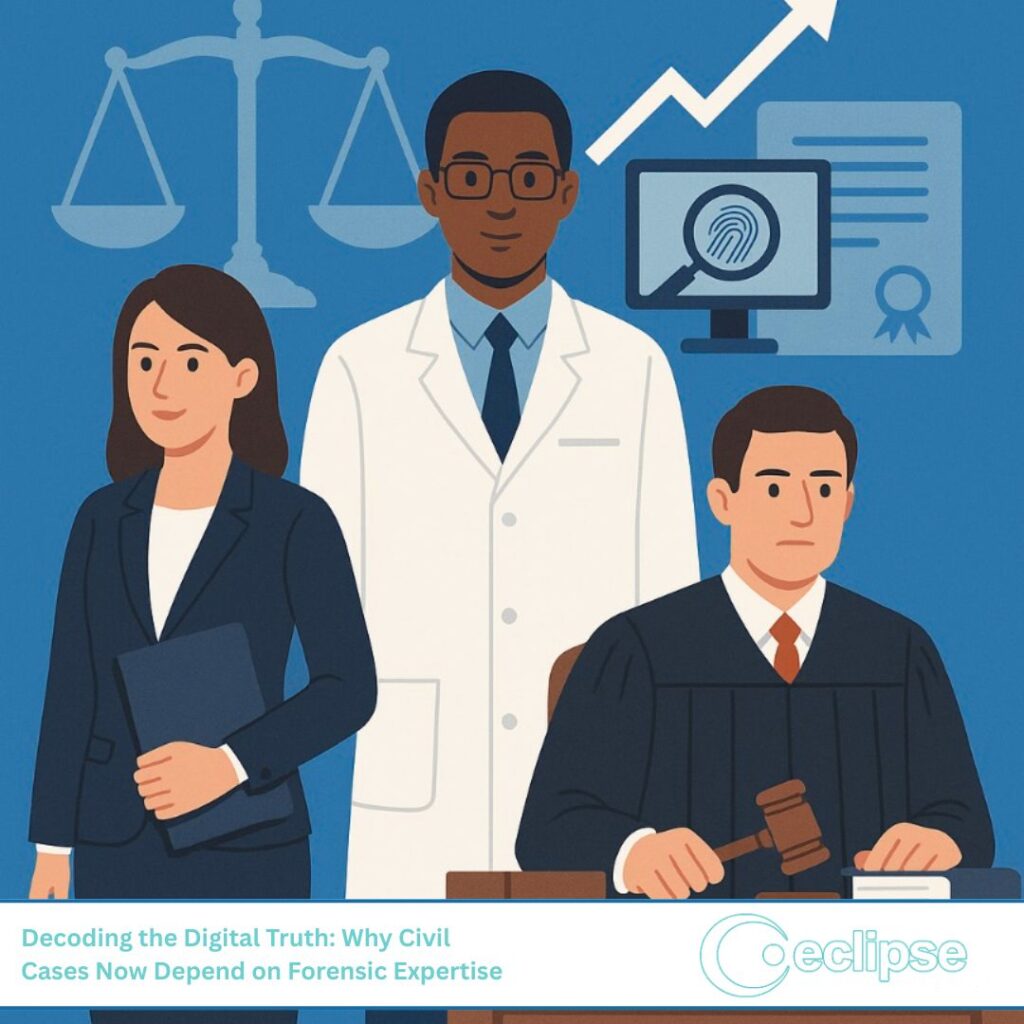
A graphic showing digital forensic experts

Understanding the Role of Digital Forensic Consultants

Digital forensic consultants are specialists trained to extract, preserve, analyze, and present digital evidence in a legally admissible manner. In civil litigation, they help attorneys and clients uncover critical information stored in electronic devices, communications, and multimedia content. Their ability to recover deleted files, analyze metadata, and interpret usage patterns makes them indispensable in today’s data-driven courtrooms.

Unlike criminal cases, civil litigation typically involves private disputes between individuals or organizations. In these scenarios, digital forensic consultants can play a crucial role in proving liability, demonstrating damage, and uncovering fraudulent behavior.

Key Drivers Behind the Growing Demand

1. Increased Digital Interactions

As nearly every communication and transaction leaves a digital footprint—emails, text messages, social media activity, mobile app usage—litigants increasingly rely on digital evidence. Civil cases involving defamation, harassment, and contract breaches often hinge on digital communications that need expert interpretation and authentication.

2. Explosion of Mobile Device Use

The proliferation of smartphones and tablets has turned mobile device forensics into a vital branch of digital investigation. These devices contain a wealth of evidence, including call logs, geolocation data, chat histories, and app usage statistics. In civil litigation, mobile device evidence can help clarify timelines, verify alibis, and confirm user behavior.

With so much sensitive data stored on mobile devices, digital forensic consultants use specialized tools to extract and preserve information without compromising its integrity. Their expertise ensures that the evidence is collected in compliance with legal protocols, maintaining its admissibility in court.

3. Complexities of Digital Multimedia Evidence

Multimedia content—such as video and audio files—has become a cornerstone in various civil cases. Whether it’s surveillance footage from a business premises or a voice recording presented in a workplace dispute, the reliability of these files often comes into question. This is where an audio forensic expert or a digital video forensics consultant becomes essential.

These professionals are trained to authenticate recordings, detect tampering, clarify speech or images, and match them to specific devices or users. Their technical reports and testimony can significantly strengthen a case by validating or refuting the content presented by either party.

4. Rise in Intellectual Property Disputes

In the digital age, intellectual property theft no longer requires physical access to documents or assets. With a few clicks, confidential data can be stolen, duplicated, or distributed online. Civil suits involving trade secrets, copyright infringement, or data breaches often require the skills of digital forensic consultants to trace digital footprints, identify the breach’s source, and quantify damages.

Types of Digital Evidence in Civil Cases

Digital forensic consultants work with a wide range of evidence sources, including:

  • Emails and Text Messages: Used to support claims of defamation, breach of contract, or harassment.
  • Social Media Activity: Helps verify statements or disprove timelines.
  • GPS and Location Data: Useful in personal injury claims or employee misconduct cases.
  • Digital Video Files: Surveillance footage or recordings used to support or refute claims.
  • Voice Recordings: In workplace disputes or verbal agreements, evaluated by an audio forensic expert.
  • Mobile Devices: Central to most modern civil cases, as they house multiple data types.
  • Cloud Storage and Backups: Can hold hidden or deleted documents and evidence.

Common Civil Litigation Cases Involving Digital Forensics

Personal Injury and Insurance Claims

In personal injury lawsuits, plaintiffs must prove the extent of injury and causation. Digital evidence, such as location data or surveillance footage, can support or contradict testimony.

Man typing something on his black laptop

Insurance companies may also use digital forensics to uncover fraud, like exaggerated claims or staged incidents.

Employment and Labor Disputes

Digital forensic consultants are often called in to analyze internal communications, mobile phone activity, or computer usage when dealing with wrongful termination, discrimination, or breach of non-compete agreements.

Divorce and Custody Battles

In family law cases, evidence from mobile phones, emails, or social media may play a pivotal role. Allegations of infidelity, hidden assets, or unfit parenting can be substantiated—or disproven—by a forensic analysis of digital devices.

Intellectual Property and Trade Secrets

Businesses use digital forensic experts to identify internal leaks, trace the theft of intellectual property, and determine how sensitive data may have been compromised or shared.

Real Estate and Contract Disputes

Digital evidence can clarify whether contractual obligations were met, using timestamped communications, transaction records, or document metadata.

The Role of Audio and Video Forensics in Civil Litigation

Importance of an Audio Forensic Expert

An audio forensic expert specializes in the analysis and interpretation of sound recordings. Their tasks may include:

  • Enhancing speech for clarity
  • Authenticating recordings
  • Detecting tampering or edits
  • Matching voices or identifying speakers

A legal person sitting stressed at a table

In civil litigation, audio experts can help determine the credibility of verbal agreements, provide evidence in harassment cases, or support claims involving workplace misconduct.

Power of Digital Video Forensics

Digital video forensics involves the examination of video footage to validate its authenticity and improve its quality. Experts may stabilize shaky video, clarify blurry images, or analyze frame-by-frame sequences to extract key details. This service is invaluable in slip-and-fall cases, auto accidents, or property disputes, where visual evidence is central to the case.

Legal and Ethical Considerations

The process of acquiring and analyzing digital evidence must adhere strictly to legal standards. Improper handling can render evidence inadmissible or raise ethical concerns. Digital forensic consultants for civil litigation are trained in the principles of chain of custody, data integrity, and privacy law compliance.

Attorneys must also be cautious not to request or submit digital evidence obtained through unauthorized means, such as hacking or surveillance, without consent. A qualified digital forensic consultant ensures all activities comply with federal and state laws, protecting the credibility of the legal process.

Digital Forensics in Pre-Litigation Strategy

Digital forensics is not limited to courtroom presentation—it plays a vital role in case preparation and settlement negotiations. By uncovering key evidence early, attorneys can:

People working on laptops at a table

  • Assess case strengths and weaknesses
  • Determine the viability of claims
  • Avoid unnecessary litigation
  • Bolster negotiation positions with strong digital proof

In some cases, digital forensic findings may encourage parties to settle out of court, saving time and costs.

Challenges and Limitations

Despite their growing importance, digital forensic investigations come with challenges:

  • Encryption and Security: High-level encryption can hinder data extraction.
  • Data Overload: Sorting through massive amounts of information requires time and expertise.
  • Rapid Technological Changes: Tools and techniques must constantly evolve to keep pace.
  • Privacy Concerns: Accessing data without violating privacy rights requires delicate handling and sometimes legal intervention, such as subpoenas.

However, skilled consultants are trained to navigate these issues while delivering reliable, legally admissible results.

Choosing the Right Digital Forensic Expert

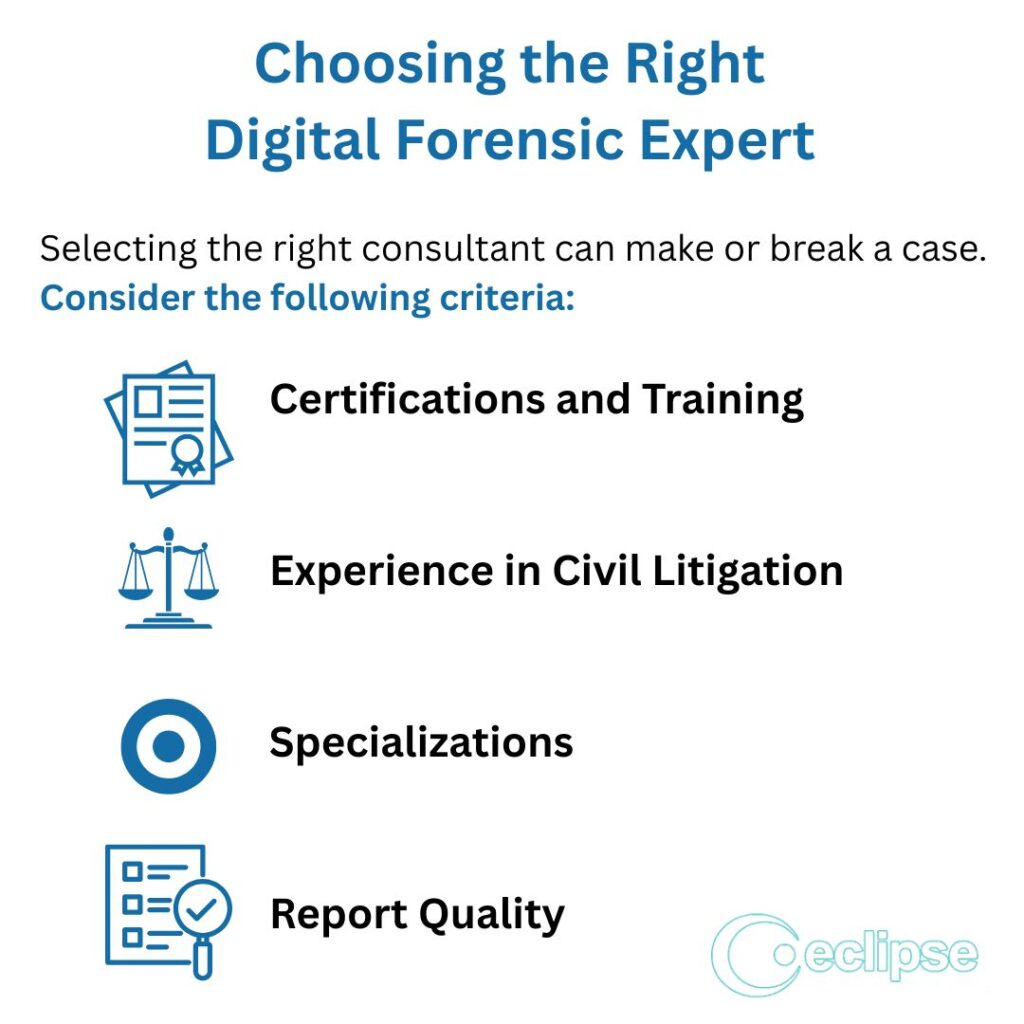
Selecting the right consultant can make or break a case. Consider the following criteria:

  • Certifications and Training: Look for credentials like CFCE (Certified Forensic Computer Examiner) or certifications in mobile forensics and video/audio analysis.
  • Experience in Civil Litigation: Ensure the consultant understands courtroom procedures and can provide expert testimony.
  • Specializations: Choose consultants with expertise relevant to your case—such as an audio forensic expert or mobile device forensics analyst.
  • Report Quality: Well-documented, easy-to-understand reports are critical for legal teams and juries alike.

A graph showing how to choose a digital forensic expert

The Future of Digital Forensics in Civil Law

As technology continues to advance, the role of digital forensic consultants will only grow. With artificial intelligence, IoT devices, and blockchain data becoming more prevalent, forensic specialists must adapt their methods and tools accordingly. New challenges, such as deepfakes or AI-generated content, may further complicate civil litigation—underscoring the need for skilled digital analysts.

At Eclipse Forensics, we specialize in uncovering the truth hidden in your digital world. Our team of digital forensic consultants for civil litigation provides expert analysis of mobile devices, video, and audio recordings to support your case with precision and credibility. Whether you need a trusted audio forensic expert to verify voice evidence or advanced mobile device forensics to recover critical messages, we deliver courtroom-ready results with integrity. Our digital video forensics services enhance, authenticate, and validate footage to ensure every visual detail is clear and admissible. Trust Eclipse Forensics to be your strategic partner in navigating complex digital evidence, because in today’s litigation landscape, every byte counts.

a digital forensic consultant working to extract data

Mobile Device Forensics: Extracting Critical Evidence from Smartphones and Tablets

In today’s digital age, smartphones and tablets have become integral parts of our daily lives, storing vast amounts of personal and professional information. These devices often play pivotal roles in investigations involving criminal activity or corporate espionage. Mobile device forensics is the specialized field that focuses on extracting and analyzing this critical data to uncover evidence that can be used in legal or investigative contexts.

The Importance of Mobile Device Forensics

Mobile devices are treasure troves of information. From call logs and text messages to social media interactions and GPS data, these devices store a wealth of data that can be invaluable in solving crimes or uncovering corporate misconduct. Digital forensic consultants employ advanced tools and techniques to retrieve and preserve this data without compromising its integrity.

Key Steps in Mobile Device Forensics

  1. Data Acquisition The first step in mobile device forensics is acquiring the data. This process involves creating a bit-by-bit copy of the device’s storage, ensuring that the original data remains unaltered. Experts use specialized hardware and software to extract data from various device types, including encrypted and damaged ones.
  2. Data Analysis Once the data is acquired, forensic experts analyze it to uncover relevant information. This may include recovering deleted files, analyzing app usage, and reconstructing communication patterns. With the help of digital forensic services, investigators can identify connections and patterns that might otherwise go unnoticed.
  3. Reporting Findings After analysis, a detailed report is compiled, presenting the evidence clearly and concisely. This report is often used in court proceedings or internal investigations.

Applications of Mobile Device Forensics

Mobile device forensics has diverse applications, including:

  • Criminal Investigations: Identifying suspects, tracing activities, and recovering evidence from mobile devices.
  • Corporate Espionage Cases: Uncovering unauthorized data transfers and identifying internal threats.
  • Personal Disputes: Resolving issues such as custody battles or harassment cases by retrieving relevant data.

Leveraging Expertise in Digital Forensics

a digital forensic consultant analyzing and extracting data

Experts in the field, such as data forensic experts, utilize a range of techniques to extract critical evidence. Their capabilities often extend to other areas of digital forensics, including forensic video analysis and forensic audio examinations. These methods ensure a comprehensive approach to uncovering the truth.

Challenges in Mobile Device Forensics

Despite its potential, mobile device forensics comes with challenges, such as:

  • Encryption: Modern devices often use advanced encryption, making data extraction complex.
  • Device Variability: The sheer variety of devices and operating systems requires forensic experts to constantly update their tools and techniques.
  • Data Overload: The massive amounts of data stored on devices can make analysis time-consuming.

Why Choose Eclipse Forensics?

At Eclipse Forensics, we specialize in mobile device forensics and provide a comprehensive suite of cell phone forensic services. Our team of digital forensic consultants and data forensic experts uses state-of-the-art tools to extract and analyze data from smartphones, tablets, and other digital devices. Whether it’s forensic video and audio analysis, or general digital forensic services, we are committed to delivering reliable and actionable results.

Contact Eclipse Forensics today to learn how our expertise can support your investigative needs. Let us help you uncover the truth hidden within mobile devices.

An image of a man using a laptop and mobile

How Mobile Forensics Ensures Personal Data Protection?

Nowadays, our smartphones have become extensions of ourselves, holding a treasure trove of personal information. From financial data to intimate photos, the stakes are high when it comes to protecting our privacy.

This is where mobile device forensics comes into play. Often associated with criminal investigations, mobile forensics is also a powerful tool for personal data protection.

1. Understanding Mobile Forensics

Mobile forensics is the process of recovering and analyzing data from mobile devices. While it’s commonly used in legal and criminal investigations, it’s also employed to protect individual privacy.

When a data breach occurs, or a device is lost or stolen, digital forensics experts can pinpoint the compromised data, identify the source of the breach, and implement measures to prevent future occurrences.

2. Protecting Against Data Breaches

One of the most critical roles of mobile forensics is to protect against data breaches. Experts can determine how the breach occurred, what data was accessed, and who might be responsible by examining a compromised device. This information is invaluable for preventing similar breaches in the future.

3. Recovering Lost or Stolen Data

Losing your phone can be a nightmare, especially if it contains sensitive information. Mobile device forensics can help recover lost or stolen data, providing peace of mind and minimizing potential damage. Experts can restore essential information by extracting data from backups or the device itself.

An image of a mobile

4. Verifying Data Integrity

In an increasingly digital world, it’s crucial to ensure that the data we rely on is accurate and unaltered. Mobile forensics can verify data integrity by examining devices for signs of tampering or manipulation. This is essential for legal proceedings, financial transactions, and personal records.

5. Digital Evidence and Legal Protection

Mobile forensics plays a vital role in legal proceedings by providing irrefutable evidence. Whether it’s to prove innocence or establish guilt, the data extracted from mobile devices can be used to support legal claims. This ensures that individuals’ rights are protected and that justice is served.

In conclusion, mobile device forensics is a multifaceted discipline that goes beyond criminal investigations. Its application in safeguarding personal data is essential in today’s digital landscape.

Mobile forensics empowers individuals to take control of their digital privacy by protecting against data breaches, recovering lost information, verifying data integrity, and supporting legal claims. As technology continues to evolve, the role of mobile forensics in protecting our personal data will only become more critical.

Protect Your Data with Digital Forensics 

Ensure your personal data remains secure with Eclipse Forensics. Our digital forensic experts specialize in mobile device forensics to safeguard your information from unauthorized access and breaches. Trust us for reliable data recovery, security enhancements, and compliance.

Contact Eclipse Forensics today for a consultation and to protect your digital life.

An image of a man holding a phone and card

Does Mobile Forensics Work on Damaged Devices?

Mobile phones have become an integral part of our lives, storing a wealth of personal and sensitive information. This reliance on smartphones has also made them crucial pieces of evidence in legal investigations. When these devices are damaged, it raises the question: can mobile device forensics still extract valuable data from cell phones?

1. Understanding Mobile Forensics

Mobile forensics is the process of recovering digital evidence from mobile devices. It involves extracting data from various components, including the phone’s memory, SIM card, and call logs. This information can be crucial in criminal investigations, civil disputes, and even corporate investigations.

2. Types of Damage and Their Impact

The extent of damage to a mobile device significantly impacts the success of digital forensic recovery. Here are the common types of damage and their potential consequences:

Physical Damage: This includes cracks, broken screens, and water damage. While a cracked screen usually doesn’t affect data recovery, water damage can be catastrophic. Water can short-circuit the device’s internal components, rendering the data inaccessible.

Software Issues: Malware, viruses, or corrupted operating systems can hinder data extraction. While digital forensic experts can often recover data in such cases, the process becomes more complex and time-consuming.

Physical Destruction: If the device is physically destroyed, such as being burned or crushed, data recovery becomes extremely challenging. In some cases, it might be impossible.

An image of a mobile

3. The Role of Advanced Techniques

Despite the challenges, advancements in forensic technology have made it possible to recover data from even severely damaged devices. Some of the techniques used include:

Chip-off Analysis: This involves physically removing the device’s memory chip and extracting data directly from it. While this method is invasive and requires specialized equipment, it can be successful in cases where the device is physically compromised.

Data Recovery Software: Sophisticated software tools can sometimes recover deleted or corrupted files from the device’s storage.

Cloud Data Extraction: If the device was synced with cloud services, data recovery might be possible through these platforms.

4. Factors Affecting Recovery Success

Several factors influence the success of mobile device forensics on damaged devices:

Time Elapsed: The sooner the device is examined after damage, the higher the chances of data recovery.

The Extent of Damage: As mentioned earlier, the severity of the damage determines the complexity and feasibility of the recovery process.

Device Model: Different phone models have varying levels of data protection and hardware configurations, which can impact data recovery efforts.

Forensic Expertise: The skills and experience of the digital forensic expert play a crucial role in the outcome of the investigation.

Recover Your Crucial Data with Mobile Device Forensics 

Struggling with a damaged mobile device? Eclipse Forensics offers expert digital forensic solutions using advanced techniques.

Contact our digital forensic consultants today to explore how our cutting-edge forensics services can help you retrieve valuable information from even the most challenging cases. Don’t let damage stop you—call now!

An image of a man using a phone

Types of Data Mobile Forensics Can Recover from Your Device

Our smartphones have become digital repositories of our lives. From personal photos and messages to financial data and browsing history, they hold a wealth of information. While this convenience is undeniable, it also raises concerns about data privacy and security.

Mobile device forensics is a field that looks into the digital footprints we leave behind on our devices, often with surprising results. Let’s explore the types of data that can be recovered through mobile forensics.

1. Call Logs and Text Messages

Perhaps the most obvious type of data recoverable through mobile device forensics is call logs and text messages. These records can reveal communication patterns, contacts, and even the content of deleted messages.

While many people might assume that deleting a message permanently erases it, forensic experts can often recover deleted data, providing a comprehensive picture of communication activities.

2. Media Files

Your smartphone is likely a treasure trove of photos, videos, and audio recordings. Mobile forensics can extract these media files, even if they have been deleted or hidden.

This can be crucial in various investigations, from criminal cases to child exploitation. Even seemingly innocuous images can reveal valuable information about a person’s life and activities.

3. Location Data

Modern smartphones are equipped with GPS capabilities, which allow them to track our location. This data is invaluable for mobile forensics.

Investigators can reconstruct a person’s movements over time by analyzing GPS data. This information can be used to corroborate alibis, identify potential crime scenes, or even track down missing persons.

An image of a mobile

4. Internet History and Browser Data

Our online activities leave digital footprints that can be recovered through mobile device forensics. Browsing history, search queries, cookies, and website bookmarks can provide insights into a person’s interests, online behavior, and even potential criminal activities.

Even if you delete your browsing history, remnants often remain on the device, waiting to be uncovered.

5. Apps and App Data

The apps we use on our phones can also be a rich source of information for digital forensic experts. Social media apps, messaging apps, and even productivity apps can store data that is relevant to an investigation.

For example, social media data can reveal communication patterns, relationships, and potential evidence of criminal activity.

Mobile forensics is a powerful tool with far-reaching implications. While it can be used to solve crimes and protect public safety, it also raises important questions about privacy and individual rights. As technology continues to advance, so too will the capabilities of mobile forensics, making it essential to be aware of the data we create and share on our devices.

Secure Your Digital Evidence With Mobile Device Forensics 

Unlock critical insights from your mobile device with Eclipse Forensics. Our digital forensic experts specialize in recovering call logs, location data, and more. Don’t leave vital information to chance—contact us now for thorough and reliable digital forensic services and mobile device forensics.

Reach out today for a consultation!

A person working simultaneously on a phone and a laptop

The 5 Main Parts of a Mobile Forensic Process

Mobile devices have become an indispensable part of modern life. They store a wealth of personal and potentially sensitive information, making them a critical element in various legal investigations. Mobile device forensics, a specialized branch of digital forensics, focuses on extracting and analyzing this data in a forensically sound manner.

Understanding the key stages of this process is crucial for anyone involved in legal proceedings where digital evidence from mobile devices plays a role.

At Eclipse Forensics, we offer a comprehensive range of cell phone forensic services, utilizing cutting-edge technology and highly trained experts to deliver accurate and reliable results. We understand the importance of meticulous procedures and strict adherence to established forensic principles throughout the mobile forensic process.

Here, we delve into the five main parts of a mobile forensic process, highlighting their importance and considerations:

1. Seizure:

  • Securing the Device:The first step involves physically securing the mobile device in question. This includes powering down the device to prevent further data modification or deletion.
  • Chain of Custody:A meticulous chain of custody record must be established, documenting who handled the device, when, and under what circumstances. This creates an auditable trail that demonstrates the device’s secure handling throughout the investigation.
  • Legal Considerations:Depending on the context of the investigation, legal authorization through a search warrant may be necessary before seizing the device. This ensures adherence to legal procedures and protects against potential legal challenges.

2. Acquisition:

  • Forensic Imaging:Following secure seizure, the primary objective becomes acquiring a bit-for-bit copy of the device’s storage. This creates a forensic image, which serves as a pristine and exact replica of the original data. This image becomes the primary source for analysis, ensuring the original device remains untouched and unaltered.
  • Acquisition Methods: Different methods exist for acquiring a forensic image, each with its own advantages and limitations:
  • Physical Extraction: This method utilizes specialized hardware tools to directly access the device’s storage chips, bypassing the operating system and security features. This approach is often preferred for its ability to capture deleted data and circumvent encryption.
  • Logical Extraction: This method involves software tools that interact with the device’s operating system to extract data. This method is generally less intrusive but may not capture all data, particularly deleted files or data residing in secure areas.
  • Device Specificity:The chosen acquisition method depends on the specific device, its operating system, and security features. Some devices may require specialized tools or techniques to overcome encryption or other security measures.

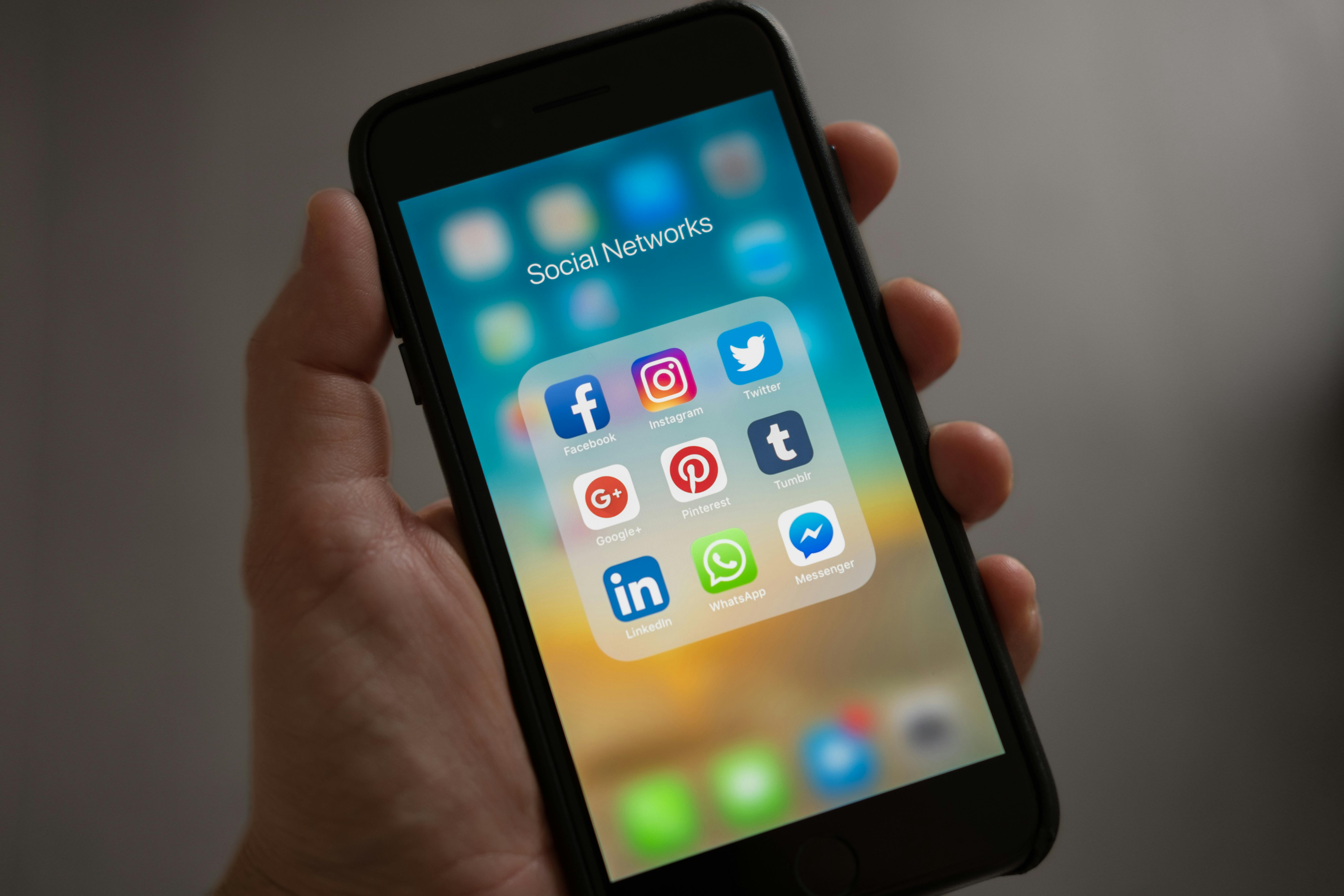
Icons of different apps on a phone screen

3. Examination and Analysis:

Following the acquisition of a forensic image, the heart of the mobile forensic process lies in the meticulous examination and analysis of the extracted data. This stage involves sifting through the vast amount of information, identifying relevant evidence, and piecing together the digital narrative within the context of the specific investigation.

1. Specialized Software

Cell phone forensics experts utilize specialized software tools designed to parse and analyze the intricate details within the forensic image. These tools provide functionalities such as:

  • File System Exploration:Navigating the device’s file system, identifying files and folders, and recovering deleted data.
  • Data Extraction:Extracting specific data types like call logs, text messages, browsing history, app data, and multimedia files.
  • Artifact Analysis:Examining metadata associated with files, revealing timestamps, origin information, and potential modifications.
  • Timeline Reconstruction:Creating a chronological timeline of device activity, capturing user actions and interactions.

2. Identifying Relevant Evidence:

The focus of the analysis shifts towards pinpointing data relevant to the specific investigation. This involves:

  • Understanding the Case Objectives:Clearly understanding the specific questions the investigation seeks to answer guides the direction of the analysis.
  • Keyword Searching:Utilizing keywords and search terms related to the case to identify relevant files, messages, or app activity.
  • Data Correlation:Correlating findings across different data types, such as call logs with text messages or browsing history with app usage patterns.
  • Identifying Anomalies:Detecting unusual or suspicious activity within the data, such as hidden files, deleted messages, or unexpected app installations.

3. Building the Digital Narrative:

The extracted and analyzed data is then synthesized into a coherent narrative that sheds light on the events under investigation. This may involve:

  • Timeline Construction:Creating a comprehensive timeline of device activity, highlighting relevant events and user actions.
  • Data Visualization:Utilizing charts, graphs, and other visual representations to illustrate complex relationships within the data.
  • Identifying Patterns:Recognizing recurring patterns or anomalies that may point towards specific activities or user behavior.

4. Documentation and Reporting:

Throughout the examination and analysis stage, meticulous documentation is crucial. This includes:

  • Detailed Logs:Maintaining detailed logs of the analysis process, including the tools used, search queries performed, and identified findings.
  • Chain of Custody:Maintaining a clear chain of custody for all extracted data, ensuring its admissibility in court.
  • Forensic Report:Generating a comprehensive forensic report that summarizes the findings, their significance, and their correlation to the case objectives.

4. Presentation and Review: Communicating the Digital Story

Following the meticulous examination and analysis, the culmination of the mobile forensic process involves presenting the findings to relevant parties and potentially defending them in legal proceedings. This stage requires clear communication and a strong understanding of the technical details to effectively convey the significance of the extracted evidence.

1. Delivering the Findings:

  • Presentation of Evidence:The extracted data, organized and analyzed, is presented in a clear and concise manner. This may involve:
  • Forensic Report:Present a comprehensive forensic report summarizing the entire process, the identified evidence, and its correlation to the case objectives.
  • Visual Aids:Utilizing charts, graphs, and timelines to illustrate complex relationships and patterns within the data.
  • Expert Testimony:In court proceedings, the cell phone forensics expert may be required to provide testimony, explaining the methodology used, the analysis conducted, and the significance of the findings in the context of the case.

2. Addressing Challenges:

A woman working on a laptop

Presenting technical data to non-technical audiences requires careful explanation and the ability to translate complex findings into understandable terms. Cell phone forensics experts must be prepared to:

  • Answer Questions:Anticipate potential questions from legal teams or the court and provide clear and concise answers that address any concerns regarding the validity of the evidence.
  • Explain Technical Concepts:Break down technical details into easily understandable language, ensuring all parties grasp the implications of the presented evidence.
  • Maintain Objectivity:Present the findings objectively, avoiding personal opinions or interpretations that could compromise the integrity of the investigation.

3. Importance of Review:

Following the presentation, a thorough review process is crucial. This involves:

  • Peer Review:Subjecting the forensic report and analysis to review by other qualified cell phone forensics experts to ensure accuracy and adherence to best practices.
  • Addressing Discrepancies:Addressing any discrepancies or challenges raised during the presentation or review process.
  • Maintaining Documentation:Updating all documentation to reflect the final findings and any adjustments made during the review stage.

By effectively presenting the digital story and navigating the complexities of legal proceedings, cell phone forensics experts play a vital role in ensuring the proper interpretation and utilization of digital evidence within the legal system.

5. Storage and Retention: Safeguarding the Evidence

The final stage of the mobile forensic process focuses on the secure storage and retention of the original device and the acquired forensic image. This ensures the continued availability of the evidence for potential future reference or re-examination.

1. Storage Considerations:

  • Secure Storage:Both the original device and the forensic image must be stored in a secure and tamper-proof environment, with restricted access to prevent unauthorized modification or contamination.
  • Data Integrity:Storage solutions should maintain the integrity of the data, ensuring no alteration or degradation occurs over time.
  • Chain of Custody:The chain of custody documentation must be maintained throughout the storage period, demonstrating the secure handling and preservation of the evidence.

2. Retention Requirements:

The duration of evidence storage is often dictated by legal requirements or the specific case details. Factors such as:

  • Statute of Limitations:Applicable legal statutes may mandate the minimum retention period for specific types of evidence.
  • Case Resolution:The resolution of the legal case may influence the required storage duration.
  • Potential Appeals:The possibility of future appeals or re-examinations necessitates extended storage periods.

3. Best Practices:

  • Regular Backups:Maintaining regular backups of the forensic image on secure storage devices ensures redundancy and protects against potential data loss.
  • Documentation:Detailed records of the storage location, access logs, and any chain of custody updates should be maintained for future reference.
  • Disposal Procedures:When the retention period expires, secure and documented procedures for the disposal of the original device and the forensic image are essential.

By adhering to strict storage and retention protocols, cell phone forensics experts ensure the long-term viability of digital evidence, safeguarding its integrity and accessibility for future legal needs.

A phone screen says 'Hello.'

Additional Considerations:

The mobile forensic process is constantly evolving as technology advances. New encryption methods, device security features, and data storage complexities necessitate ongoing research and adaptation of forensic techniques. Cell phone forensic expert must possess a deep understanding of these technological advancements and maintain their expertise through continuous training and professional development.

Eclipse Forensics understands the critical role of mobile device forensics in legal investigations. Our team of highly qualified cell phone forensics experts utilizes advanced technology and proven methodologies to conduct thorough and reliable examinations.

We are committed to preserving the integrity of digital evidence throughout the entire process, ensuring its admissibility in court, and providing our clients with the insights they need to navigate complex legal matters.

If you require assistance with forensic cell phone data recovery or any other aspect of mobile device forensics, contact Eclipse Forensics today by calling (904) 797-1866. We are here to help you navigate the complexities of digital evidence and ensure that your case receives the meticulous attention it deserves.